





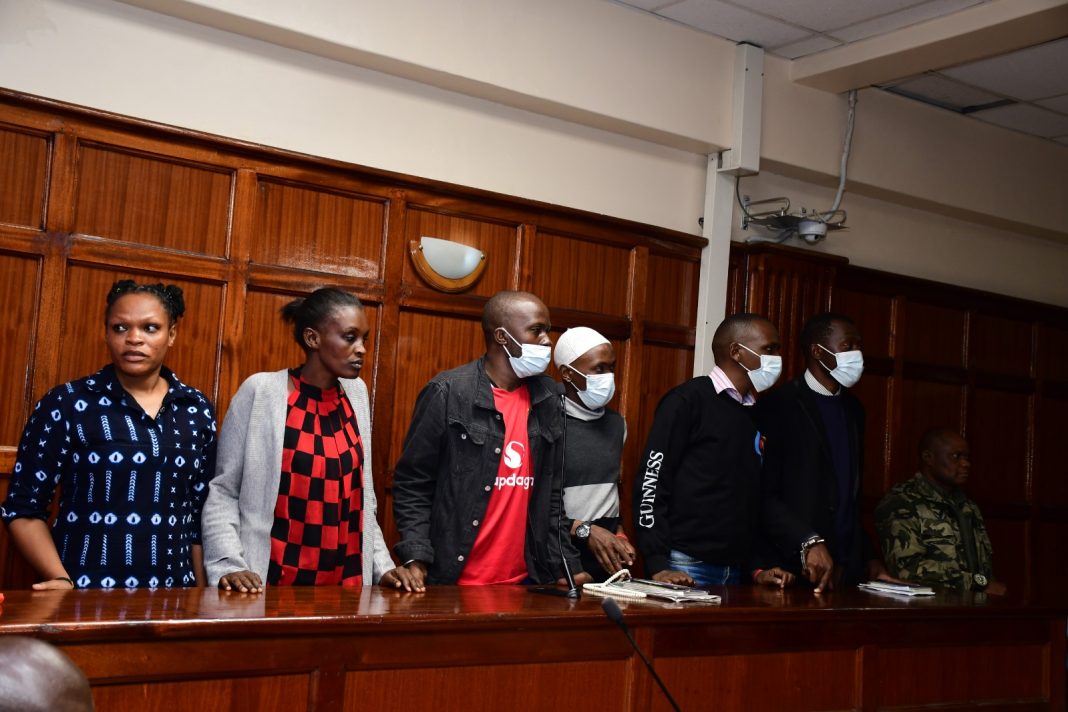
A Nairobi court has sentenced four men to death over the murder of former Kabete Member of Parliament George Muchai, bringing closure to a case that has taken more than a decade to conclude.
The ruling was delivered on Thursday, April 9, at the Milimani Law Courts by Chief Magistrate Lucas Onyina, who found the four guilty of robbery with violence linked to the 2015 killing. Two other accused persons were sentenced to 10 years in prison after being convicted of unlawful possession of firearms and ammunition.
According to court proceedings, the six were part of a gang involved in a violent robbery that led to the deaths of Muchai, his two bodyguards and his driver during a night attack in Nairobi’s Central Business District.
The prosecution told the court that the gang, armed with firearms, ambushed the former legislator along Kenyatta Avenue in February 2015, executing a coordinated attack that shocked the nation.
In his judgment, Onyina said the prosecution had presented sufficient and credible evidence linking the four main convicts to the fatal robbery. He noted that the nature and gravity of the offence met the legal threshold required to impose the death sentence under Kenya’s laws on robbery with violence.
“The evidence placed the accused persons at the centre of the crime and demonstrated their active role in the execution of the robbery that resulted in multiple deaths,” the court ruled.
For the two other convicts, the magistrate noted that while they were connected to the broader criminal activities, there was no direct evidence placing them at the scene during the attack. As a result, they received custodial sentences of 10 years each.
Muchai, who was serving his first term as Kabete MP at the time of his death, was a prominent figure known for his role in trade union leadership before transitioning into politics. His killing remains one of the most high-profile political assassinations in Kenya’s recent history.
During the trial, prosecutors presented evidence linking the accused to a string of organised robberies carried out in Nairobi around the same period. The court observed that the attacks bore similar patterns, including the use of firearms and coordinated execution, which strengthened the case against the suspects.
The conclusion of the case marks a significant milestone in the pursuit of justice, with families of the victims and the public having waited years for accountability over the shocking killings.