





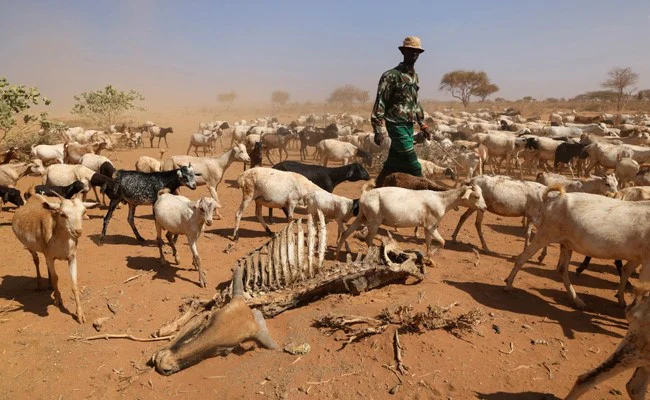
Kenya is grappling with an escalating food insecurity crisis after the near-total failure of the October–December 2025 short rains, the International Federation of Red Cross and Red Crescent Societies (IFRC) has warned. Rainfall across much of the country reached only 30 to 60 percent of normal levels, marking the driest short-rains season since 1981 in eastern regions.
The dry spell has compounded previous poor seasons, straining crops, water sources, and rangelands while temperatures 1–2°C above average have worsened conditions. According to the National Drought Management Authority (NDMA), 23 counties are now experiencing drought stress. Nine counties, including Wajir, Garissa, Marsabit, and Kitui, are on “Alert,” with Mandera in critical “Alarm” status. Even traditionally stable counties like Samburu, Turkana, Nyeri, Laikipia, and Meru show worsening conditions.
Currently, 2.1 to 2.5 million Kenyans face hunger, with pastoral households particularly affected due to poor pasture regeneration, dwindling water supplies, and declining livestock productivity. Water scarcity has intensified, forcing families to travel longer distances, while livestock migrations raise conflict risks in areas such as Turkana, Marsabit, and Tana River.
The government and humanitarian agencies are responding with emergency interventions including food distribution, water trucking, nutrition screenings, and livestock support. Legislators have urged the drought to be declared a national disaster to unlock additional resources. Climate forecasts indicate below-average rains may persist into early 2026, meaning food assistance may be required for up to 3.5 million people by May. Children under five and pregnant or lactating women remain most vulnerable to malnutrition, while displaced populations from Somalia and Ethiopia further strain resources.
Sustained humanitarian support and longer-term resilience measures, such as irrigation expansion, are critical to mitigate the effects of this worsening crisis.


 has warned. Rainfall across much of the country reached only 30 to 60 percent of normal levels, marking the driest short-rains season since 1981 in eastern regions.)
Can I just say what a relief to find someone who actually knows what theyre talking about on the internet. You definitely know how to bring an issue to light and make it important. More people need to read this and understand this side of the story. I cant believe youre not more popular because you definitely have the gift.
I would like to thank you for the efforts you have put in writing this website. I am hoping the same high-grade blog post from you in the upcoming also. In fact your creative writing skills has encouraged me to get my own site now. Actually the blogging is spreading its wings quickly. Your write up is a good example of it.
Wow! This blog looks just like my old one! It’s on a totally different subject but it has pretty much the same page layout and design. Superb choice of colors!
What i don’t realize is in truth how you are no longer really a lot more well-liked than you might be right now. You’re very intelligent. You already know therefore significantly relating to this subject, produced me for my part imagine it from a lot of varied angles. Its like women and men aren’t interested unless it is something to do with Girl gaga! Your own stuffs nice. At all times care for it up!
I enjoy the efforts you have put in this, thankyou for all the great content.
A powerful share, I just given this onto a colleague who was doing slightly analysis on this. And he in truth purchased me breakfast because I found it for him.. smile. So let me reword that: Thnx for the treat! But yeah Thnkx for spending the time to discuss this, I feel strongly about it and love reading extra on this topic. If doable, as you grow to be expertise, would you mind updating your blog with more particulars? It’s highly helpful for me. Big thumb up for this weblog put up!