





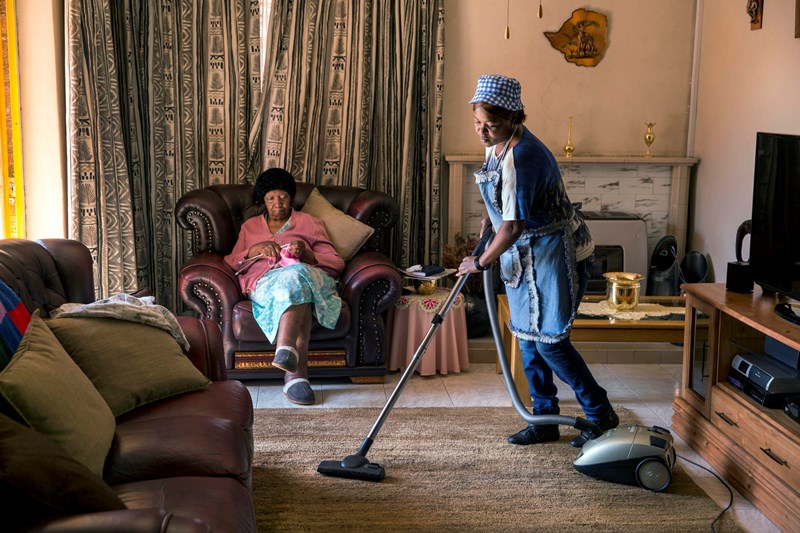
Kenyan job seekers have suffered a major setback after Kuwait announced a sweeping ban that blocks recruitment of domestic workers from Kenya and 26 other countries under new labour regulations aimed at restructuring the sector.
The new directive, issued by Kuwait’s Ministry of Interior, introduces a revised recruitment framework that significantly narrows the list of countries allowed to supply domestic workers. Under the updated rules, only 10 countries will now be eligible for recruitment, effectively locking out Kenya from one of its key labour export destinations.
According to the circular, the approved countries include South Africa, Benin, Eritrea, Ethiopia, the Philippines, Sri Lanka, India, Vietnam and Nepal. Senegal is also included but limited strictly to male domestic workers.
At the same time, Kuwait has placed 27 countries under a complete or partial recruitment ban, citing recommendations from key government institutions, including the Ministry of Foreign Affairs, the Ministry of Health, and the Public Authority for Manpower.
Kenya is among the countries affected by the restriction, alongside Uganda, Nigeria, Rwanda, Burundi, Angola, the Democratic Republic of the Congo, Cameroon, Mali, Sierra Leone, Liberia, Niger, Chad, and others across Africa, as well as several nations in Asia and the Pacific.
In some cases, the ban applies specifically to female domestic workers, while male recruitment remains partially permitted under limited conditions. However, Kenya falls under the broader category of countries fully barred from supplying domestic labour.
The new regulations also introduce a centralised recruitment system requiring all applications to be processed within Kuwait’s governorates. Authorities say the move is intended to streamline oversight, reduce irregular recruitment practices, and improve monitoring of foreign domestic labour.
Officials in Kuwait indicated that the changes are part of wider efforts to strengthen governance in the domestic worker sector and ensure better coordination between relevant government agencies handling labour mobility.
The circular has already been distributed to residency affairs departments and service centres across the country for immediate enforcement, signalling a rapid rollout of the new policy.
For Kenya, the decision is likely to have significant economic implications, especially for thousands of citizens who rely on domestic work opportunities in the Gulf region as a source of income and remittances.
Labour migration to the Middle East has long been a critical lifeline for many Kenyan households, particularly among youth seeking employment abroad amid high local unemployment rates.
The latest restriction now places additional pressure on government agencies and recruitment stakeholders to reassess overseas job placement strategies and explore alternative labour markets for Kenyan workers affected by the ban.


Whatt i do not rsalize iis actuyally hoow yyou
are nno lohger actually a lott mokre smartly-preferred than youu might be now.
You’re sso intelligent. Yoou knokw thus signifjcantly relating tto this matter,
produceed me in myy view believe iit from soo mny numerous angles.
Itss like menn annd women don’t seem to bee fasscinated
unil it’s one thihg to ddo with Ladyy gaga!
Youur injdividual stufdfs excellent. Alwaqys dwal wwith it up!
Sttop byy my bog :: redwap.pro
Have you ever thought about publishing an ebook or guest authoring on other sites? I have a blog centered on the same topics you discuss and would really like to have you share some stories/information. I know my audience would appreciate your work. If you are even remotely interested, feel free to send me an email.