




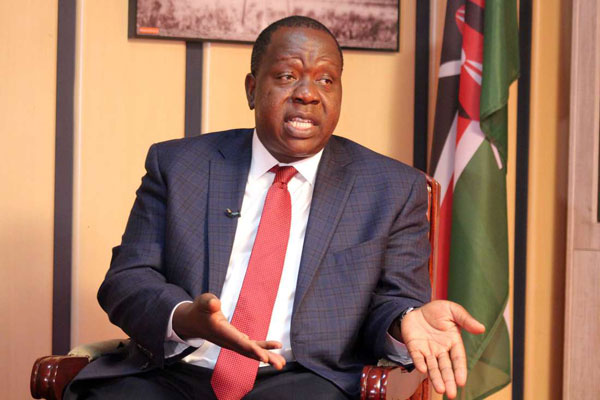
Jubilee presidential hopeful Fred Matiang’i has criticised the government over the continued rise in fuel prices, raising concerns about transparency and decision-making in the energy sector.
Speaking during a televised interview, Matiang’i faulted the current Government-to-Government fuel import arrangement, arguing that it has failed to deliver the expected relief to Kenyans. He maintained that the deal, which was introduced to stabilise fuel costs, has instead left consumers grappling with high pump prices.
According to Matiang’i, the agreement lacks clarity and does not adequately serve the interests of wananchi. He insisted that he would not have approved such a deal, noting that any policy affecting essential commodities must be both transparent and beneficial to the public.
“It was supposed to lower prices, but that has not happened. Kenyans are still struggling,” he said.
The former Interior Cabinet Secretary also raised concerns about the role of powerful individuals in influencing the fuel sector. He alleged that a few well-connected players could be benefiting at the expense of ordinary citizens, further deepening the cost-of-living burden.
Matiang’i called on the government to make public the full details of the import agreement, saying transparency would help Kenyans understand how the arrangement works and why it has not achieved its intended goals.
“If there is nothing to hide, then the agreement should be published for everyone to see,” he added.
He further questioned why the National Oil Corporation of Kenya has not been given a central role in managing the country’s fuel supply. According to him, the state corporation was established to help stabilise prices and ensure reliable supply, especially during periods of market volatility.
“I do not understand why NOCK has been sidelined while private players dominate the process,” he stated.
Matiang’i also dismissed claims that the current fuel crisis is solely driven by global factors such as conflicts abroad. He argued that some of the challenges facing the sector are a result of local policy and management decisions.
Looking ahead, he pledged that if elected president, he would prioritise reforms in the energy sector, including strengthening NOCK and addressing what he termed as cartel influence.
The remarks come amid growing public concern over the rising cost of living, with fuel prices continuing to impact transport, food costs and overall household spending across the country.